You bought some crypto. Now it just sits in your wallet. Every morning you check the number.
Green day, you feel rich. Red day, you feel sick. "Buy and wait" is currently the only move you know.
Here is what nobody told you: While you waited, someone was getting paid. When people borrow to buy more crypto, a lender earns interest. When people swap one coin for another, someone collects the fee.
Every move a normal user makes pays someone on the other side. We have taught this to 721 people in 90 countries. The moment it clicks is always the same. They stop asking "which coin will go up" and start asking "how do I get on the other side."
"In DeFi, you can be the player or you can be the house. Most people never know the second seat exists."
That other side is what this post is about. Plain words. No jargon.
What Does "Be the Bank" Mean in DeFi?
Transitioning from a passive holder to an active participant allows you to capture the value flowing through the ecosystem rather than just watching it.
Being the bank in DeFi means you earn the fees and interest that other crypto users pay. A normal user buys a coin and bets on the price. You lend your coins, supply coins for trades, or borrow against what you own.
You get paid for the activity itself, not for guessing the market right. Think of a casino. Players win some nights and lose others.
The house wins almost every night because it takes a small cut of every bet. In DeFi, you can choose to take the house's seat.
Why "Buy and Hope" Is the Weakest Move
Relying solely on price appreciation is a limited strategy that leaves significant yield on the table.
Buying a coin and holding it pays you in one case only: the price goes up. If it stays flat, you earn nothing. If it drops, you lose. You take all the risk and skip every other way to earn. It is the smallest seat in the room.
Picture owning a hotel and only sleeping in one room. The other 200 rooms sit empty. No guests, no rent. You own the whole building and use almost none of it.
That is the buy-and-hope investor. Crypto can do many things, yet they make it do only one: sit still and wait.
The Three Main Ways to Be the Bank
There are multiple avenues to generate income in decentralized finance, each serving a different market need.
There are three simple ways to earn from crypto without guessing prices: lend your coins out, borrow against your coins instead of selling them, and supply coins for trades. Each one pays you for what other people are already doing in the market.
Lending: You put your coins into a lending app; other people borrow them and pay you interest. Lending stablecoins pays about 5 to 8 percent a year, and more when demand is high. The borrower takes the loss if their bet fails, but you keep the interest.
Borrowing the Smart Way: If you believe your Bitcoin will rise, don't sell it for cash. Instead, borrow stablecoins against it. You keep the upside of the Bitcoin while putting the borrowed cash to work earning yield elsewhere.
Supplying Coins for Trades: Every time someone swaps one coin for another, they pay a small fee. That fee goes to the people who supplied the coins for that swap. You earn a little on every transaction, regardless of which way the market moves.
There is a quiet bonus on top of all three: you can put your earnings back to work so they earn too. This creates a snowball effect.
A 4 percent monthly return does not just give you 48 percent a year; it gives you 60 percent because each month grows on a larger base. It starts small and picks up momentum with every roll.
Customer vs. Bank: Same Crypto, Different Outcome
The role you play in the market dictates your risk profile and your potential for consistent returns.
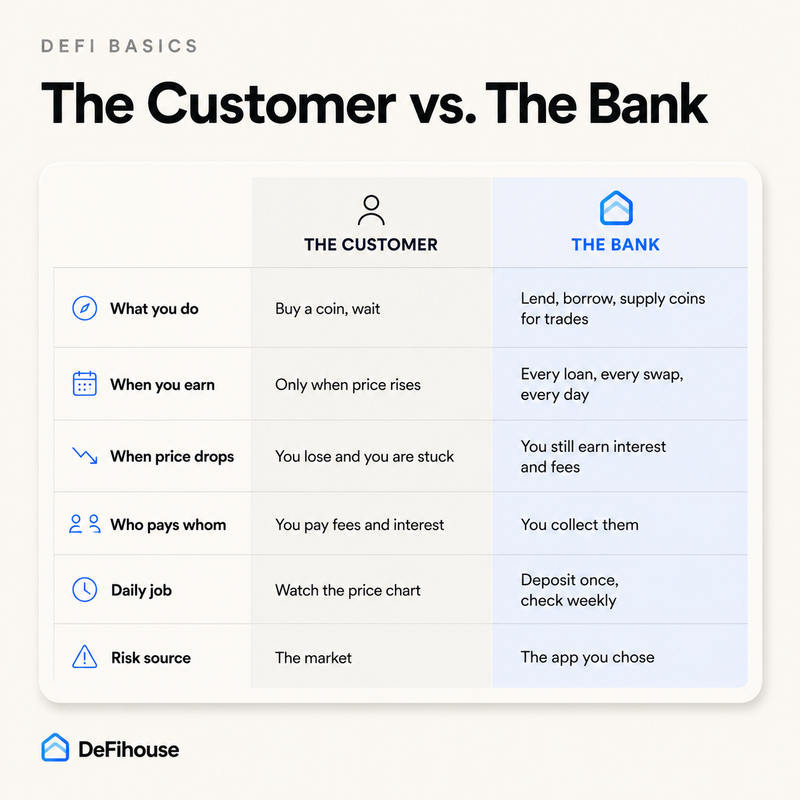
A customer only wins when the price rises and pays fees the whole time. The bank earns interest and fees every day, in any market, and even gets paid when other traders lose. Same money to start, very different result.
The customer's income rides on a coin flip. The bank's income rides on activity, and there is always activity. People trade, borrow, and panic in every market. All of it pays the house.
How to Start Your DeFi Journey This Week
You don't need a massive portfolio to begin; you just need a willingness to learn the mechanical side of the market.
Set up your own wallet: Use a wallet where you hold your own keys. Write your recovery words on paper and keep them safe.
Start with a stablecoin: Move a small amount of a stablecoin in so price swings do not distract you while you learn.
Deposit into a lending app: Choose an app with a long track record and billions of dollars in total value locked. Size and age are your safety signals.
Observe: Perform no trades for a week. Watch the balance grow and realize you are earning while you sleep.
One honest word, because we say it to every beginner: DeFi is not free money. Rates change and software can have bugs.
This is not financial advice. Never put in money you cannot afford to lose while you learn. The customer checks the price and hopes; the bank checks the balance and keeps building.
Frequently Asked Questions
Is being the bank in DeFi safe for beginners?
It is generally safer than buying speculative coins, but not risk-free. Lending and supplying coins through well-tested apps protects you from individual borrower defaults because loans are over-collateralized. The real risks are software bugs and fluctuating interest rates.
How much money do I need to start?
You can begin with about $100. This low barrier to entry is what makes DeFi different from traditional banking, where the best rates are often reserved for those with large balances. Start small to learn the mechanics before scaling up.
Do I need to know how to code?
No. These activities happen through user-friendly apps with simple buttons for depositing, borrowing, and withdrawing. The two vital skills are identifying trusted applications and keeping your private keys secure.